
Why your freezer keeps building up frost
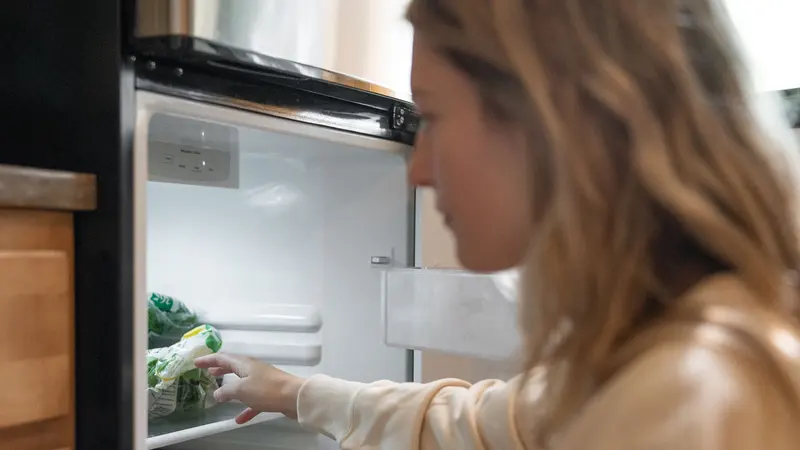 Refrigerator
Photo: Kevin Malik / Pexels
Refrigerator
Photo: Kevin Malik / Pexels A frost-free freezer that keeps growing a layer of ice is telling you something specific. The defrost system is supposed to melt away any frost every eight to twelve hours automatically. When ice survives that cycle, either humid air is getting in, or the defrost system has stopped working.
How frost-free actually works
Every eight to twelve hours of compressor run time, the control board cuts cooling and energizes a defrost heater wrapped around the evaporator coil. A defrost thermostat or bimetal terminates the cycle once the coil reaches roughly 40-60°F, and the meltwater drains away. Three parts, one board. Any of them failing produces the same visible symptom: growing ice.
Cause one: humid air getting in
A door left ajar, a worn gasket or a misaligned door lets moist room air into a compartment held near 0°F, and that moisture immediately becomes frost. Check for a gasket that has hardened or torn at the corners, and confirm the door closes on its own from a few inches open. In a humid Chicago summer, a marginal seal frosts up quickly.
Cause two: a failed defrost heater
The heater is a glass or calrod element clipped under or through the evaporator coil. It fails open, and once it does, ice accumulates until it blocks all airflow, typically over two to six weeks. A tech confirms it with a resistance check rather than by eye. Replacement generally runs $200-$380 including labor.
Cause three: defrost thermostat or sensor
The defrost thermostat closes only at low temperatures to allow the heater to run. When it fails open, the heater never energizes even though everything else works. On newer boards, a bimetal is replaced by a thermistor feeding the control. Both are inexpensive parts, and both produce ice patterns identical to a bad heater, which is why testing beats guessing.
Cause four: the control board or timer
Older units use a mechanical defrost timer; newer ones run defrost logic on the main control board. If the board never initiates the cycle, the heater and thermostat can both be perfectly good. This is the most expensive of the four at $300-$650, and it should only be replaced after the cheaper components have been tested and cleared.
Frost patterns give clues
Even frost across the whole rear panel usually means a defrost system failure. Frost concentrated near the door or one corner points to a seal or air leak. Snow-like ice on food packages, rather than the coil, often means the door was open or the unit is set colder than needed. Look at where the ice is before you assume the worst.
What to do right now
Verify the door seals and that nothing blocks it from closing, set the freezer to about 0°F rather than the coldest setting, and avoid loading warm food in large batches. If ice returns within a month of a manual defrost, the defrost system is at fault and needs testing. That is a same-day service call in most of Chicagoland.
Frequently asked questions
Does manually defrosting fix the problem?
It restores airflow temporarily, but if a defrost component has failed, the ice will return in a few weeks. Treat it as relief, not a repair.
Is a thin even layer of frost on the coil normal?
Yes. A light frost on the evaporator between defrost cycles is expected. Solid ice that bridges the coil fins is not.
Can frost buildup raise my electric bill?
Yes. Ice insulates the coil, so the compressor runs far longer to reach the same temperature, and the fresh food section often warms up too.